

2026 · All levels
Can You Learn Japanese by Watching Anime? The Honest Answer
For many people, anime is the reason they first became interested in Japanese. A single series can spark curiosity about the language, culture, food, and everyday life in Japan. Some viewers begin memorising phrases naturally, while others eventually search for a beginner Japanese class after realising they want to understand conversations without subtitles.
At Bunka Language School, we regularly meet students who started their journey through anime before exploring more structured options like hybrid and online Japanese classes in Singapore or a dedicated Japanese online lesson programme. The enthusiasm is genuine, and anime can absolutely become part of the learning process.
Still, there is a difference between recognising phrases from a show and developing real communication skills.
So, can you learn Japanese by watching anime?
Yes, to a certain degree. Anime can improve listening familiarity, expose you to common expressions, and keep you motivated. However, it also has limitations that many learners only realise later. Without proper structure, learners often struggle with grammar, sentence construction, reading skills, and natural conversation.
The key is understanding what anime can realistically help with and where guided learning becomes necessary.
Key Takeaways
- Anime can improve listening familiarity and help learners feel more comfortable hearing spoken Japanese regularly.
- Many anime characters use exaggerated or unrealistic speech patterns that do not reflect everyday conversation.
- Watching anime alone rarely develops strong grammar, writing, or conversational accuracy.
- Combining anime exposure with structured Japanese online lesson programmes creates more balanced language development.
- Learners studying Japanese in Singapore often progress faster when they pair entertainment with guided practice and real conversation.
Why Anime Feels Like an Effective Way to Learn Japanese
 Source: Envato
One reason anime feels effective is because it creates emotional engagement. Traditional study methods can sometimes feel repetitive, especially for beginners who are unfamiliar with Japanese sentence structures. Anime, on the other hand, gives learners stories, personalities, humour, and emotional moments that make the language feel alive.
That emotional connection matters more than people realise.People are more likely to continue learning when they enjoy the process. Someone who watches Japanese content regularly may stay engaged longer than someone relying entirely on textbooks.
Anime also introduces learners to the natural rhythm of spoken Japanese. Even when viewers do not fully understand every sentence, repeated exposure trains the ear to recognise sounds, recurring vocabulary, and conversational flow. Over time, phrases begin to sound familiar rather than overwhelming.
For students enrolled in online Japanese classes in Singapore, this familiarity can make listening exercises feel less intimidating. Learners often notice that they can recognise sentence endings or emotional tones more quickly because they have already heard similar patterns repeatedly in anime.
The Biggest Misconception About Learning Japanese Through Anime
 Source: Envato
One of the most common misunderstandings among beginners is assuming that regular exposure automatically leads to fluency. While anime can absolutely support language learning, it cannot fully replace structured study and real conversational practice.
Many learners eventually realise that despite watching hundreds of episodes, they still struggle to form sentences naturally or understand conversations outside familiar scenes. This happens because anime is designed primarily for entertainment rather than education.
Anime Dialogue Is Often Exaggerated
Anime characters frequently speak in stylised or dramatic ways that do not always reflect everyday communication. Certain characters may sound intentionally rough, overly emotional, childish, or theatrical depending on the genre and personality being portrayed. In fantasy or action series, the vocabulary can become even less practical for real-world situations. Learners who copy these speech patterns directly may unintentionally sound unnatural or overly aggressive in actual conversations.Real-Life Japanese Depends Heavily on Context
For students interested in learning Japanese in Singapore for travel, work, or communication purposes, understanding social nuance is extremely important. Japanese communication changes depending on:- Relationship
- Age
- Professional Setting
- Social Hierarchy
- Level Of Familiarity
Subtitles Can Create False Confidence
Another challenge is that subtitles often give learners the illusion that they understand more Japanese than they actually do. Most subtitles are adapted for natural English readability rather than direct translation. Because of this, learners may emotionally follow scenes while missing the actual sentence structure and grammatical nuances being used in Japanese. Over time, viewers may recognise recurring phrases without fully understanding how the language functions independently.What Anime Actually Helps You Learn
Anime becomes much more useful when learners understand its strengths realistically. While it cannot replace structured learning entirely, it can support certain aspects of language development surprisingly well when used alongside proper study.Anime Improves Listening Familiarity
One of the biggest advantages of anime is repeated listening exposure. Hearing Japanese regularly helps learners become more familiar with pronunciation, pacing, sentence rhythm, and emotional tone. Even when viewers do not fully understand every sentence, repeated exposure gradually trains the ear to recognise recurring sounds and conversational patterns more naturally. Over time, learners often notice that Japanese starts sounding less overwhelming and more predictable.Anime Helps Develop Pronunciation Awareness
Japanese pronunciation is generally more consistent than English, which means repeated listening can help learners become more comfortable with sound patterns and intonation. By hearing native speech regularly, learners begin recognising how certain syllables flow together and how emotional tone changes delivery. This type of exposure can make pronunciation practice feel more natural during structured lessons or conversation exercises.Anime Introduces Everyday Vocabulary
Anime also exposes learners to common conversational vocabulary through repetition. Greetings, reactions, emotional expressions, and simple everyday phrases often appear repeatedly across different series. However, context still matters greatly. Some vocabulary may be highly casual, exaggerated, or tied to fictional situations, so learners benefit most when they combine exposure with guided learning that explains how and when certain expressions are actually used.The table below shows where anime can genuinely help and where learners usually need additional support.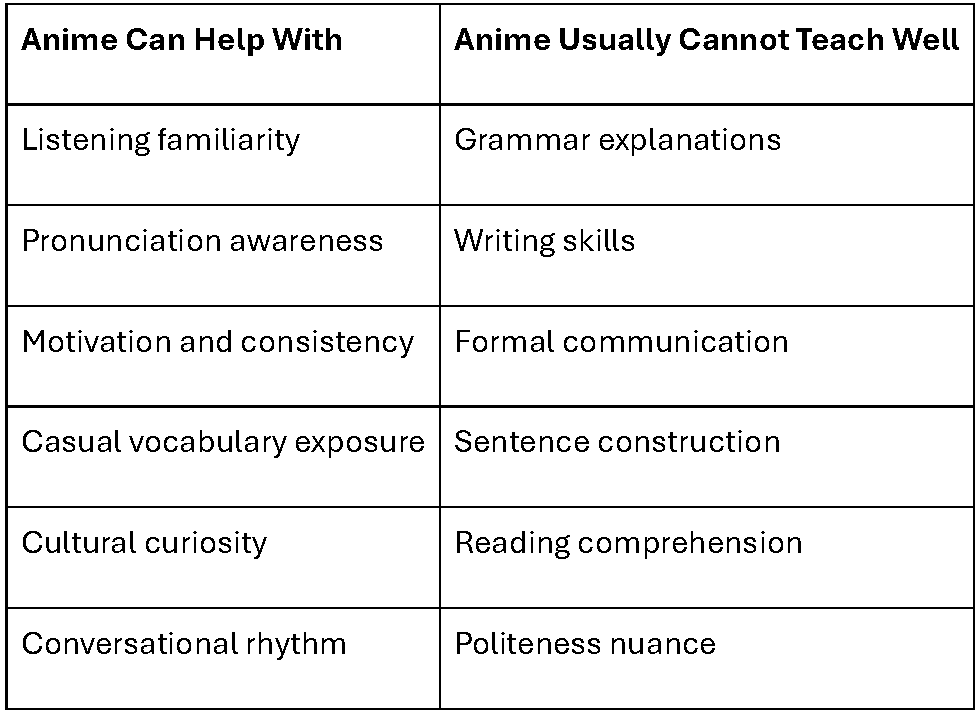
For this reason, anime works best as supplementary exposure alongside a beginner Japanese class or structured Japanese online lesson programme.
Why Structured Learning Still Matters
Many learners resist structured classes initially because anime feels more enjoyable and less formal. However, most eventually realise they need guidance once they try building sentences independently or participating in real conversations.A structured learning environment provides progression. Instead of learning disconnected phrases randomly, students gradually understand how Japanese grammar works as a complete system.This includes:- Sentence structure
- Verb forms
- Particles
- Conversational context
- Reading systems
- Practical vocabulary usage
The Difference Between Understanding Anime and Understanding Japanese
Many learners experience a surprising moment when they begin formal lessons. They realise they were recognising sounds emotionally without fully understanding the language itself.For example, learners may recognise recurring phrases in anime but struggle when:- The speaking speed changes
- Subtitles disappear
- Grammar becomes more formal
- Conversations occur naturally
- Unfamiliar vocabulary appears
How to Use Anime More Effectively While Learning Japanese
Anime becomes far more valuable when learners use it intentionally rather than passively. While it should not replace structured study, it can become a strong listening and reinforcement tool when approached correctly.Choose Anime With More Natural Conversations
Some anime genres are more useful for learners than others. Slice-of-life series, school dramas, and workplace-focused stories usually contain more realistic conversational Japanese compared to fantasy-heavy or action-driven shows. Because these series focus on everyday situations, learners are more likely to hear practical vocabulary and conversational patterns that appear in real life.Rewatch Short Scenes Instead of Constantly Watching New Episodes
Many learners benefit more from repetition than constant exposure to new content. Rewatching short scenes helps listeners recognise pronunciation patterns, sentence endings, and recurring vocabulary more naturally. Over time, familiar phrases become easier to identify without relying immediately on subtitles.Focus on Context Instead of Memorising Random Phrases
One common mistake learners make is memorising isolated expressions without understanding why characters speak differently in certain situations. Japanese communication changes depending on relationships, age, familiarity, and social setting. Paying attention to context often teaches learners far more than simply copying phrases directly from anime dialogue. Some learners also find it helpful to pause occasionally and note:- Unfamiliar vocabulary
- Recurring sentence patterns
- Emotional tone shifts
- Polite versus casual speech
Common Anime Phrases That Beginners Recognise
One reason anime feels useful for language learning is that viewers naturally become familiar with certain Japanese expressions through repetition. Even complete beginners often recognise phrases after watching enough episodes.Some commonly recognised examples include:- Arigatou (Thank you)
- Sugoi (Amazing)
- Daijoubu (It's okay)
- Itadakimasu (Said before eating)
- Oyasumi (Good night)