

2026 · All levels
Which Japanese Language Should I Learn First? Standard, Formal, or Casual Explained
Many beginners imagine Japanese as a single, uniform language until they begin learning and realise that people speak very differently depending on the situation. A conversation between close friends may sound completely different from a workplace interaction or a customer service exchange. Add anime, dramas, YouTube content, and textbooks into the mix, and it becomes easy to feel overwhelmed.
This is why many new learners eventually ask the same question: Which Japanese language should I learn first?
At Bunka Language School, we often hear this from students exploring a Japanese language class in Singapore that they can realistically sustain over the long term. Some worry that learning polite Japanese first will make them sound stiff or unnatural. Others feel tempted to focus entirely on casual Japanese because it sounds more conversational in entertainment and social media.
The reality is that Japanese communication works in layers. Standard, formal, and casual Japanese each serve different purposes, and learners do not need to master all of them immediately. What matters most in the beginning is building a foundation that allows you to communicate clearly, respectfully, and confidently.
For most people planning to study Japanese in Singapore, standard polite Japanese is usually the best place to begin. Once learners understand how the language works structurally, transitioning into casual and more advanced forms becomes much more natural.
Key Takeaways
- Japanese communication changes depending on social context, relationships, and levels of politeness.
- Most beginners benefit from starting with standard polite Japanese because it is flexible and widely appropriate.
- Casual Japanese becomes easier to understand after learners develop grammar foundations first.
- Formal Japanese is important in professional environments but is usually introduced progressively.
- A structured Japanese language school in Singapore can help learners understand how speech styles change naturally in real conversations.
Why Japanese Has Different Ways of Speaking
 Source: Envato
One reason Japanese can initially feel intimidating is because learners quickly notice that people do not always speak the same way. Unlike English, where changes in formality are often subtle, Japanese communication reflects social relationships much more directly.
The way someone speaks to a close friend may differ significantly from how they speak to:
- A Teacher
- A Colleague
- An Older Relative
- A Customer
- A Stranger
Even in English, people usually communicate differently in professional settings compared to relaxed conversations with friends. Japanese simply makes these distinctions more visible within the language itself.
For beginners, however, exposure to different speech styles at the same time can become confusing. Anime characters may sound extremely casual, textbooks often introduce polite sentence structures, and business-related content may use highly formal expressions that seem completely unrelated.
Without clear explanations, learners sometimes feel as though they are studying three different languages at once. This is one reason many students Enroll in a Japanese language class in Singapore, where instructors can explain how standard, casual, and formal Japanese connect to one another. Understanding how these communication styles relate helps make Japanese feel much more manageable.
Why Most Beginners Start With Standard Japanese
 Source: Envato
When learners first begin studying Japanese, they are usually introduced to standard polite Japanese rather than highly casual speech or advanced business Japanese. This is not because formal communication is considered more important than everyday conversation. It is because this foundation is the most stable and versatile for beginners.
Polite Japanese is practical in a wide range of real-world situations. Whether you are ordering food, introducing yourself, speaking with teachers, asking for directions, or interacting with colleagues, polite speech is generally viewed positively.
Even if your grammar is still simple, speaking politely usually sounds respectful rather than awkward.
This makes standard Japanese far safer for beginners than jumping immediately into casual speech patterns that may carry unintended tones or social implications.
Polite Japanese is not "robotic Japanese." It simply provides a clear and reliable foundation while learners build confidence.
More importantly, standard Japanese teaches learners how the language functions underneath the surface. Sentence patterns, verb forms, particles, and conversational structure become easier to understand before learners gradually encounter more relaxed variations later.
For students attending online Japanese classes in Singapore while balancing work or school schedules, this structure often makes the learning process feel far less overwhelming.
The Appeal and Challenge of Casual Japanese
Many learners become interested in casual Japanese very early because it is the version they hear most often in anime, dramas, gaming content, and social media videos. Casual speech sounds expressive, emotional, and natural, which makes it feel more exciting than textbook dialogue.There is nothing wrong with being curious about casual Japanese. In fact, understanding casual conversation eventually becomes important for learners who want to communicate comfortably with friends or consume Japanese media naturally.However, casual Japanese is often more nuanced than beginners realise.Casual Japanese Depends Heavily on Social Context
In Japanese, the appropriateness of casual speech depends heavily on relationships and social context. The same phrase may sound perfectly natural between close friends but inappropriate in a classroom or professional setting. This is where self-study learners sometimes struggle. Without understanding the social framework behind the language, it becomes easy to memorise expressions without knowing when they should actually be used.Entertainment Does Not Always Reflect Real Conversation
Anime and dramas also complicate things further because fictional characters often speak in exaggerated ways designed to match specific personalities. Certain characters may sound intentionally rough, childish, overly dramatic, or unusually formal for entertainment purposes. As a result, copying anime dialogue directly into real-life conversation can occasionally create awkward situations. For learners planning to study Japanese in Singapore for travel, work, or personal growth, this distinction becomes important. Real communication depends not only on vocabulary but also on tone, timing, and social awareness.Casual Japanese Becomes Easier With Strong Foundations
Interestingly, casual Japanese usually becomes easier once learners already understand polite Japanese first. Many casual forms are simply shortened or modified versions of standard sentence structures. Learners with strong grammar foundations often transition into casual speech naturally over time because they can recognise how the language changes depending on context.Understanding Formal Japanese Without Feeling Intimidated
Formal Japanese tends to create anxiety for beginners because it is often associated with strict workplace communication and advanced politeness rules. While formal Japanese is certainly important in professional environments, most learners do not need to master advanced business communication immediately.In reality, formal Japanese is usually introduced gradually.Most learners first develop:- Basic Grammar Foundations
- Conversational Confidence
- Listening Familiarity
- Standard Polite Communication
When Formal Japanese Becomes Important
Formal Japanese is particularly useful for:- Business Communication
- Customer Service Roles
- Corporate Environments
- Professional Emails
- Workplace Interactions
Choosing the Right Starting Point Based on Your Goals
Different learners naturally have different reasons for studying Japanese. Someone preparing for travel may prioritise different skills compared to someone working with Japanese clients professionally.Still, most learning pathways share one common pattern: standard polite Japanese usually comes first.The table below offers a simple overview of how different goals may influence learning priorities.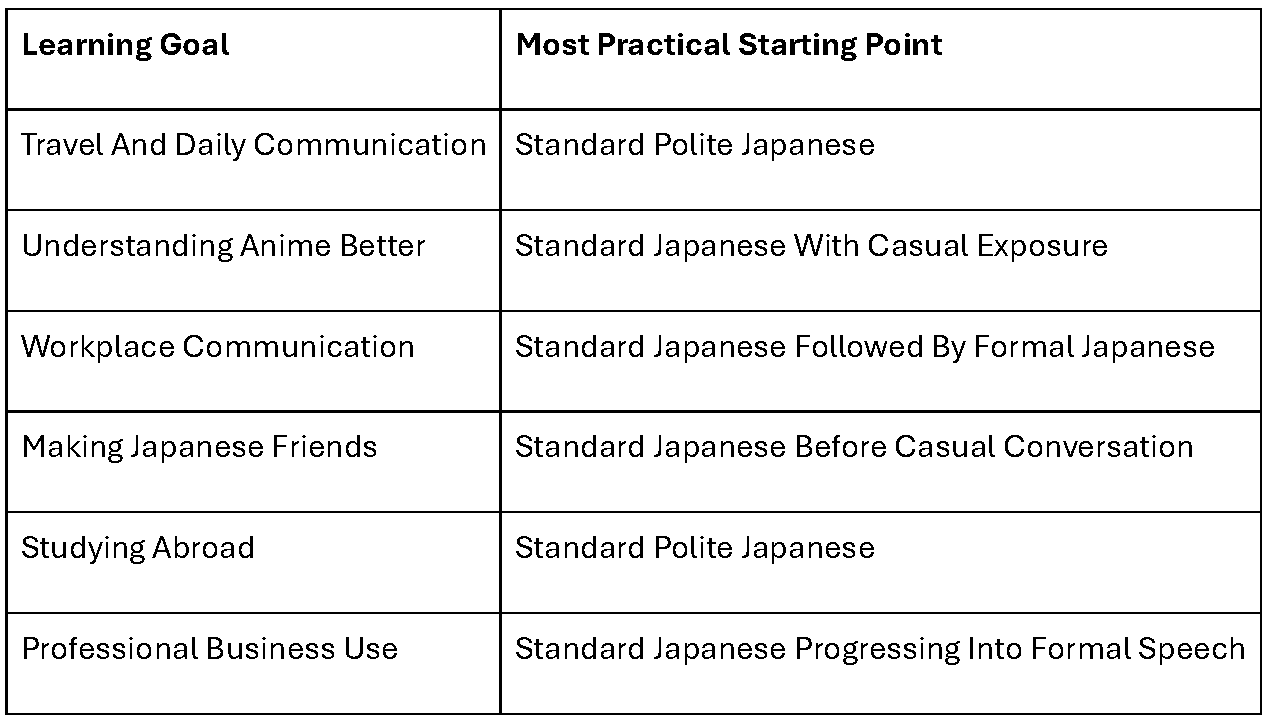
This approach allows learners to communicate respectfully first while gradually expanding into more natural conversational flexibility later.
For many adults taking online Japanese classes in Singapore, this progression also feels psychologically easier. Instead of trying to “sound native” immediately, learners focus on becoming understandable, confident, and comfortable step by step.
Common Situations Where Different Japanese Styles Are Used
Many beginners find it easier to understand Japanese speech levels when they see them in practical situations rather than as abstract grammar concepts.For example: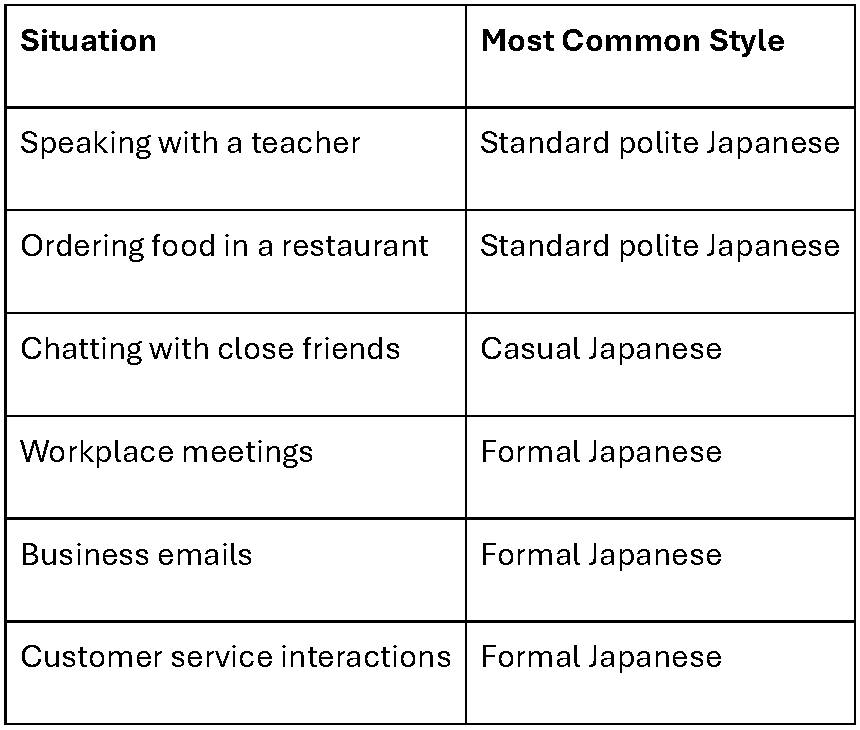
The goal is not to memorise every speech style immediately. Instead, learners should understand that different situations naturally require different levels of politeness. As language skills improve, choosing the appropriate communication style becomes much more intuitive.